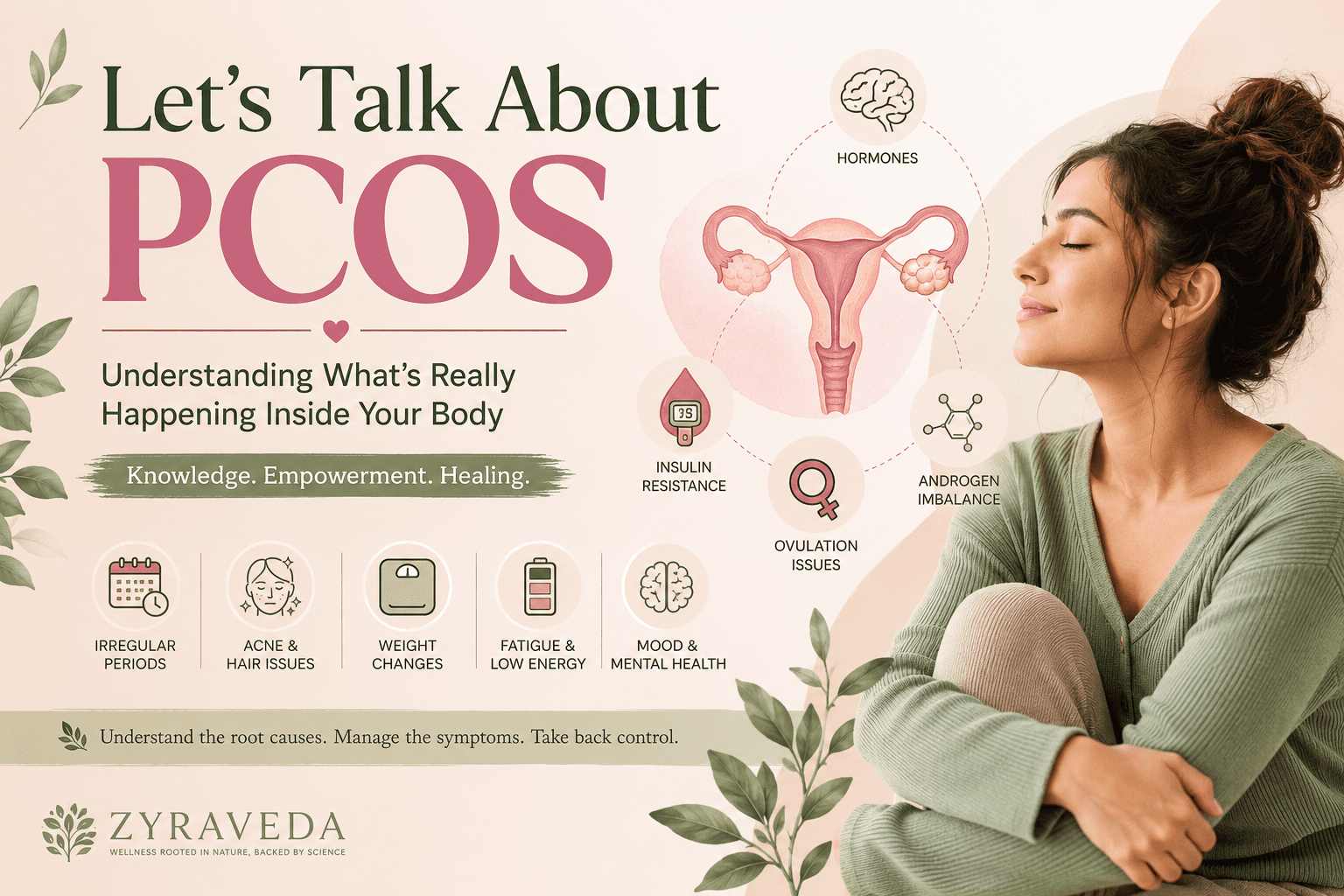
If you’ve been diagnosed with PCOS or suspect you may have it, you’ve probably spent hours searching online, reading medical articles, watching videos, and trying to make sense of all the information available. Yet despite all that research, many women are still left wondering:
What exactly is PCOS, and what is happening inside my body?
You’re not alone.
PCOS (Polycystic Ovary Syndrome) is one of the most common hormonal disorders affecting women worldwide. It is estimated to affect approximately 1 in 8 women of reproductive age, impacting millions of women across the globe. Research also suggests that the number of diagnosed cases has increased significantly over the past few decades, making PCOS an increasingly important women’s health concern.
The good news? Understanding PCOS doesn’t have to be complicated.
Let’s break it down in a simple way.
What exactly is PCOS?
Think of your body as a team that relies on communication to function properly.
Your brain is constantly communicating with your ovaries, which are responsible for producing eggs and reproductive hormones.
The communication between these two systems is carried out by hormones, which act as messengers.
Under normal circumstances, these messages travel smoothly, helping regulate your menstrual cycle, ovulation, metabolism, mood, and overall health.
With PCOS, however, these hormonal messages become disrupted.
As a result, communication between the brain and ovaries becomes less efficient, causing the body to function differently. This disruption can affect several systems throughout the body, leading to symptoms such as:
- Irregular or missed periods
- Weight gain or difficulty losing weight
- Hormonal acne
- Excess facial or body hair growth
- Hair thinning or hair loss
- Fertility challenges
- Fatigue
- Mood changes and mental health struggles
- Metabolic dysfunction
Contrary to popular belief, PCOS is not just an ovarian condition. It is a complex hormonal and metabolic disorder that can impact many areas of health.
What Are Hormones and Why Are They Important?
Hormones are chemical messengers that help regulate many essential functions within your body.
They influence:
- Hunger and appetite
- Sleep patterns
- Energy production
- Hair growth
- Mood and emotions
- Menstrual cycles
- Fertility
- Blood sugar regulation
In PCOS, some hormones become overactive while others become less effective, creating an imbalance that contributes to many of the symptoms women experience.
The Key Hormones Involved in PCOS
Insulin
Think of insulin as a key.
Its job is to unlock your cells and allow glucose (sugar) from your bloodstream to enter and be used as energy.
Testosterone
Although often referred to as a male hormone, women naturally produce testosterone in smaller amounts.
It plays important roles in:
- Muscle health
- Bone strength
- Libido
- Mood and cognitive function
Estrogen
Estrogen is one of the primary female reproductive hormones.
It helps regulate:
- Menstrual cycles
- Reproductive health
- Bone health
- Cardiovascular function
- Pregnancy support
Luteinizing Hormone (LH)
LH plays a critical role in reproduction by helping trigger ovulation and supporting the menstrual cycle.
Follicle-Stimulating Hormone (FSH)
Produced by the pituitary gland, FSH stimulates ovarian follicles to grow and mature, preparing an egg for ovulation.
What Is Actually Happening in PCOS?
While PCOS affects everyone differently, three major processes are commonly involved.
1. Insulin Resistance
For many women, insulin resistance is one of the primary drivers of PCOS.
When the body’s cells become less responsive to insulin, the pancreas compensates by producing more insulin.
This excess insulin can contribute to:
- Increased cravings
- Fat storage and weight gain
- Fatigue
- Difficulty losing weight
- Hormonal imbalances
- Acne
Insulin resistance doesn’t just affect blood sugar—it also has a direct impact on reproductive hormones.
2. Elevated Androgen Levels
High insulin levels can stimulate the ovaries to produce higher amounts of androgens, often referred to as “male hormones.”
Elevated androgen levels can contribute to symptoms such as:
- Excess facial hair
- Increased body hair growth
- Hormonal acne
- Oily skin
- Hair thinning or hair loss on the scalp
These hormonal changes can significantly affect both physical and emotional well-being.
3. Ovulation Problems
When insulin and androgen levels become elevated, normal ovulation can be disrupted.
Instead of fully maturing and releasing an egg each month, ovarian follicles may stop developing before ovulation occurs.
This can lead to:
- Irregular periods
- Missed periods
- Difficulty conceiving
- Multiple small follicles visible on ultrasound
It’s important to note that the “cysts” associated with PCOS are usually not true ovarian cysts. They are often immature follicles that did not complete the ovulation process.
What Causes PCOS?
The exact cause of PCOS is still not fully understood, but researchers believe it develops through a combination of factors, including:
- Genetics and family history
- Insulin resistance
- Hormonal imbalances
- Chronic low-grade inflammation
- Environmental influences
- Stress and lifestyle factors
These factors interact with one another, creating the hormonal and metabolic disruptions associated with PCOS.
Can PCOS Be Cured?
Currently, there is no permanent cure for PCOS.
However, that does not mean you are powerless.
PCOS can often be managed extremely effectively through lifestyle modifications, nutrition, exercise, stress management, sleep optimization, and medical support when necessary.
Many women are able to:
- Improve menstrual regularity
- Reduce acne
- Improve fertility
- Support healthy weight management
- Increase energy levels
- Improve metabolic health
- Reduce symptoms significantly
Important Truths About PCOS
PCOS Is Not Just About Weight
Women of all body sizes can have PCOS.
While weight gain is a common symptom, it is not required for diagnosis.
Many women with “lean PCOS” experience hormonal imbalances despite having a normal body weight.
PCOS Can Affect Mental Health
PCOS doesn’t only impact the body—it can also affect the mind.
Many women experience:
- Anxiety
- Depression
- Brain fog
- Low motivation
- Emotional exhaustion
This is not simply emotional weakness. Hormonal imbalances can directly influence mood, energy, and mental well-being.
The Most Important Thing to Understand About PCOS
PCOS is not one isolated problem.
It works more like a domino effect.
One hormonal imbalance influences another system, which then affects another system, creating a chain reaction throughout the body.
The encouraging part is that positive changes can create chain reactions too.
For example:
- Better sleep → Improved insulin sensitivity → Fewer cravings
- Strength training → Better blood sugar control → Improved hormone balance
- Balanced meals → Stable energy levels → Better mood and appetite control
Small, consistent habits can create meaningful improvements over time.
Everything else—weight, acne, fertility, cravings, energy, mood, and menstrual irregularities—connects back to these core mechanisms.
Understanding your body is the first step toward supporting it.
At ZyraVeda, our goal is not just to help you manage PCOS but to help you understand it, so you can make informed decisions and build a healthier relationship with your body.

Leave a Reply